

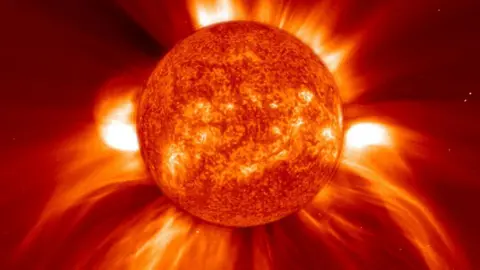
Regarding Aditya-L1, the year 2026 will be like no other.
This marks the initial occasion the observatory – which was placed into space recently – will be able to watch the Sun during its maximum activity cycle.
According to research, it comes approximately once every 11 years as the Sun's magnetic poles flip – the Earth equivalent could be the North and South poles swapping positions.
This period marked by intense activity. It involves the Sun changing from peaceful to violent and is marked by a huge increase in the number of solar storms and coronal mass ejections (CMEs) – enormous clouds of plasma that blow out from the solar corona.
Composed of charged particles, a coronal mass ejection may have a mass up to a trillion kilograms and can attain velocities exceeding 2,000 miles each second. It can head out toward various directions, even toward the Earth. At maximum velocity, it would take an ejection 15 hours to cover the vast distance Earth-Sun distance.
"In the normal or quiet periods, the Sun launches a few solar eruptions daily," explains an astrophysics expert. "In 2026, it's anticipated them to be 10 or more daily."
Studying coronal mass ejections ranks among the most important research goals of India's first solar observatory. One, as these eruptions provide an opportunity to study the Sun at the centre of our planetary system, and secondly, because activities that take place on the Sun threaten infrastructure on our planet and in space.

Impacts on Our Planet and Orbital Systems
CMEs seldom present immediate danger to human life, yet they impact our planet through generating geomagnetic storms that impact the weather in Earth's vicinity, where nearly 11,000 satellites, comprising Indian satellites, orbit.
"The most beautiful displays of a CME include northern lights, being direct evidence that solar particles from our star are travelling to Earth," the expert explains.
"But they can also cause electronic systems aboard spacecraft malfunction, disable power grids and affect meteorological and telecom spacecraft."
Historical Solar Incidents
- The most powerful solar event in history was the 1859 solar superstorm which knocked out communication systems worldwide
- In 1989, sections of Canadian electrical network failed, affecting millions in darkness for nine hours
- During late 2015, solar activity disturbed air traffic control, causing disruption across Scandinavia and some other European air hubs
- Recently in 2022, an ejection had led to dozens of spacecraft being lost
With capability to see events on the Sun's corona and spot solar activity or solar eruption in real time, record its temperature at origin and watch its trajectory, it can work as advanced warning to shut down power grids and spacecraft redirecting them to safety.
The Mission's Special Capability
While other space observatories watching our star, Aditya-L1 holds an edge over others when it comes to watching the corona.
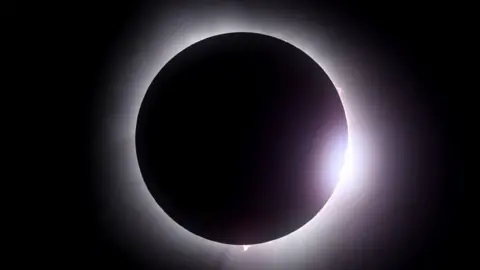
"Aditya-L1's coronagraph has perfect dimensions that lets it nearly mimic the Moon, completely blocking the solar disk permitting an uninterrupted view of nearly the entire solar atmosphere around the clock, throughout the year, including during eclipses and occultations," says the expert.
In other words, the coronagraph functions as an artificial Moon, blocking the solar glare to let researchers constantly study its faint outer corona – a feat natural eclipses provide only during eclipses.
Additionally, this is the only mission capable of examining eruptions in visible light, letting it determine a CME's temperature and thermal output – crucial data indicating how strong of an eruption if it headed our direction.
Preparation for Maximum Activity
To prepare for the upcoming solar maximum, researchers collaborated to study information obtained from a major solar eruption that Aditya-L1 has observed recently.
This event began in September 2024 at 00:30 GMT. Its mass totaled billions of tons – the iceberg that struck the ship weighed much less.
At origin, the heat reached extreme levels with energy equivalent was equivalent to millions of tons of explosives – relative to the atomic bombs used in Japan were much smaller and 21 kilotons respectively.
Even though these figures make it sound massive, the expert describes it as a moderate event.
The space rock which wiped out prehistoric life on our planet was 100 million megatons and when the Sun's maximum activity cycle, we could see eruptions carrying power matching even more than that.
"In my view this eruption we evaluated happened during periods of typical solar activity. This establishes the standard for future comparison assessing what is in store when the maximum activity cycle arrives," he states.
"The insights from this will assist in developing protective measures to be adopted safeguarding spacecraft in orbit. They will also help achieving deeper knowledge of near-Earth space," he adds.


